
NJRC is preparing participants for changes to SNAP and Medicaid/NJ FamilyCare.
To help NJRC identify your needs and provide appropriate application and documentation assistance, please complete the appropriate NJRC intake form below:
PRESS HERE
Final application and eligibility determinations are made by the appropriate county and State agencies.
Maintaining Medicaid (healthcare) and SNAP (food stamps) Benefits
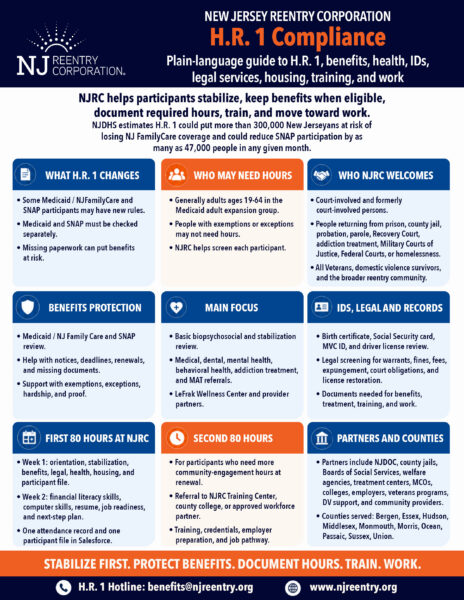
NJRC assists persons returning from prison or jail, persons in recovery from addiction, and veterans to keep access to Medicaid/NJ FamilyCare health insurance and SNAP food assistance.
New federal rules under Public Law 119-21 / H.R. 1 require some participants to document work, training, education, treatment status, disability, or other information to continue using Medicaid and food stamps.
Medicaid and SNAP are different programs. NJRC will screen each participant separately for Medicaid and SNAP eligibility, exemptions, work requirements, community-engagement requirements, notices, and documents.
NJRC will help you understand whether you qualify, whether your eligibility may change, what documents are needed, and how to respond to notices so that benefits are not lost due to missing or unclear paperwork.
NJRC's H.R. 1 Compliance Brochure
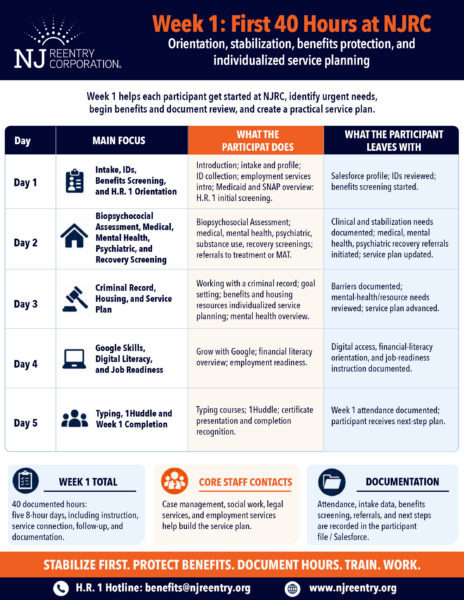
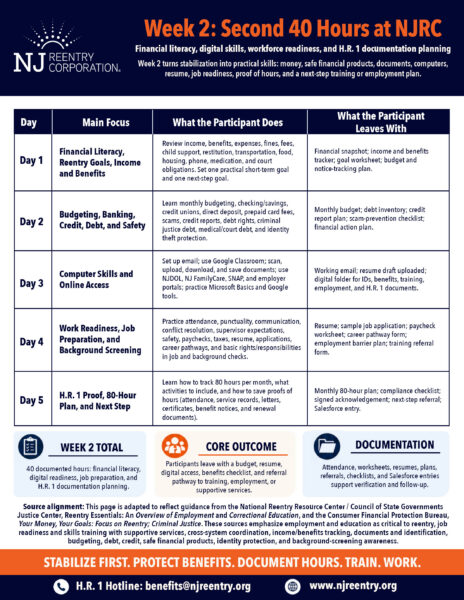
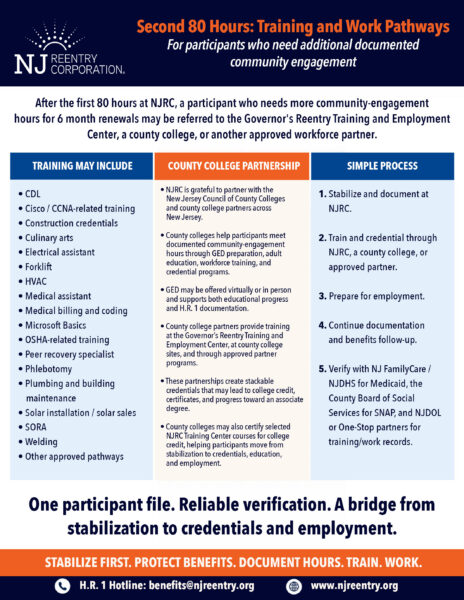
What changed?
SNAP food assistance
Beginning in November 2025, certain SNAP recipients called Able-Bodied Adults Without Dependents, or ABAWDs, must meet SNAP work requirements unless an exemption applies.
You may be subject to the SNAP ABAWD rule if you are: 18 through 64 years old; physically and mentally able to work; and not living in a SNAP household with a child under age 14.
If you are subject to the rule, you may need to document work, a work program, education, SNAP Employment and Training, workfare, or another approved activity. SNAP rules must be reviewed separately from Medicaid rules.
Medicaid / NJ FamilyCare health coverage
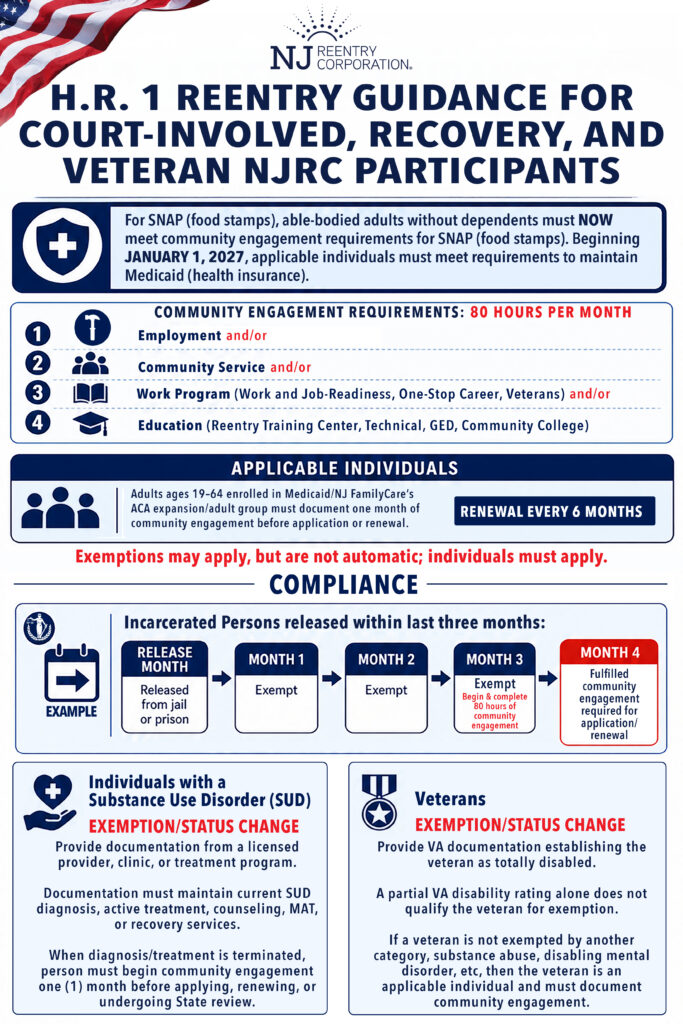
Beginning January 1, 2027, certain adults enrolled in Medicaid/NJ FamilyCare, called “applicable individuals,” may need to meet “community-engagement” requirements unless they qualify for an exclusion or exception.
You may be an “applicable individual” for Medicaid community engagement if you are: 19 through 64 years old; enrolled in, or applying for, Medicaid/NJ FamilyCare’s adult expansion group; and not covered by an exclusion or exception.
What counts as community engagement?
If you are required to meet Medicaid community engagement or SNAP work requirements, NJRC will help you join activities that may count.
Required activities include:
- Employment
- Approved work programs, job training, or NJRC Reentry Training Center classes
- Education, GED, technical school, or community college
- Community service
- A combination of approved activities totaling at least 80 hours per month
- OR Sufficient income, where permitted ($580 per month based on federal minimum wage × 80 hours)
Exemptions and exceptions may apply
Exemptions are not automatic. Participants must be screened, and documents may be required.
NJRC will help participants apply for exemptions or exceptions and will help gather and preserve documents.
1. Returning from prison or jail
If you were released from prison or jail, you may qualify for a Medicaid community-engagement exception.
For Medicaid, a person who was an inmate of a public institution during the three-month period before the first day of a month may be exempted from Medicaid community engagement for that month. NJRC will help document your release date, facility, correctional records, and when the requirement may begin.
Example: If you are released from jail or prison in March, NJRC will review whether you are temporarily exempted from Medicaid community engagement requirements for March, April, May, and June under the public-institution lookback rule.
If no other exemption or exception applies, you may need to begin meeting the 80-hour monthly community-engagement requirement in July. NJRC will help determine the correct start month and what documents are needed.
2. Substance use disorder, addiction treatment, mental health, or medical condition
If you have a substance use disorder, are in addiction treatment, receive mental health care, have a disabling mental disorder, are medically frail, or have a serious medical condition, you may qualify for an exemption, exclusion, exception, or hardship review.
NJRC will help request records from licensed providers, clinics, hospitals, treatment programs, IOP programs, recovery programs, or mental health providers.
Helpful documents may include treatment letters, diagnosis records, medication records, attendance records, discharge papers, hospital records, counseling records, MAT records, or provider verification.
3. Veterans
NJRC will screen veterans for all Medicaid and SNAP categories.
For Medicaid, a veteran with a total disability rating may qualify for a specific exclusion. NJRC will help obtain and preserve VA documentation, such as a VA award letter or rating decision. A partial VA disability rating alone may not qualify for that specific total-disability exclusion.
For SNAP, veteran status alone is no longer a separate exception under the new federal SNAP guidance, but veterans may still qualify for another SNAP exemption based on disability, medical condition, inability to work, household status, or other applicable rules.
Veterans will be screened for every other possible exemption, including disability, medical frailty, substance use disorder, mental health condition, treatment participation, homelessness, hospitalization, caretaker status, or other hardship.
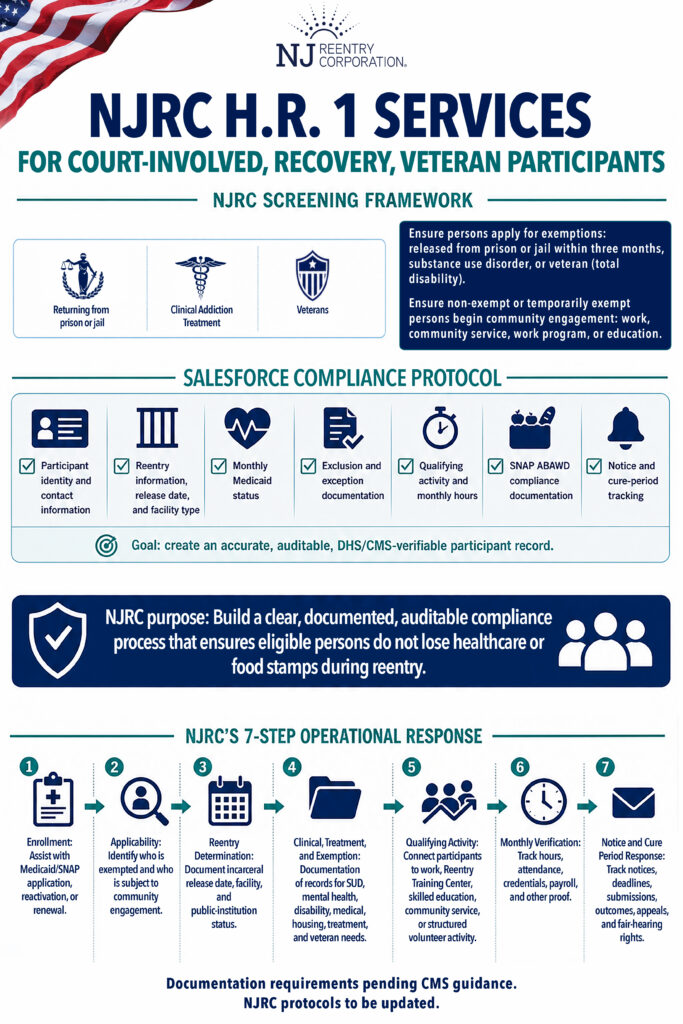
What NJRC will do to help?
1. Apply for or renew Medicaid/NJ FamilyCare and SNAP.
2. Determine whether Medicaid or SNAP work rules may apply.
3. Identify possible exemptions, exclusions, exceptions, or hardship categories.
4. Collect documents from prisons, jails, treatment providers, hospitals, employers, schools, VA, and public agencies.
5. Connect participants to training, education, employment, community service, or other qualifying activities.
6. Track monthly hours, attendance, training, employment, and other proof.
7. Respond to notices, missing-document requests, cure periods, appeals, and fair-hearing deadlines.
8. Preserve documentation in Salesforce, so there is a clear, organized participant record.
NJRC’s goal is simple: help eligible participants keep health coverage and food assistance while building stability, recovery, employment, and successful reentry.
Important Reminders
Please do not ignore any Medicaid, NJ FamilyCare, SNAP, or county notice. Bring the notice to NJRC as soon as possible.
If a notice gives you a deadline, NJRC will help you respond, gather documents, and submit proof before the deadline whenever possible. CMS guidance states that when Medicaid compliance cannot be confirmed, the State must provide notice, a 30-day response period, and fair-hearing rights before adverse action.
For More Information
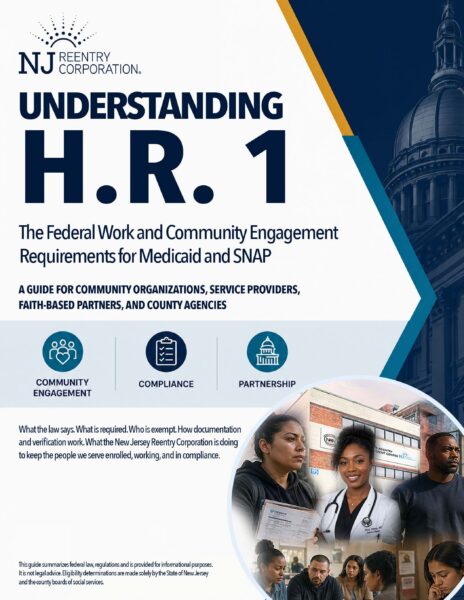
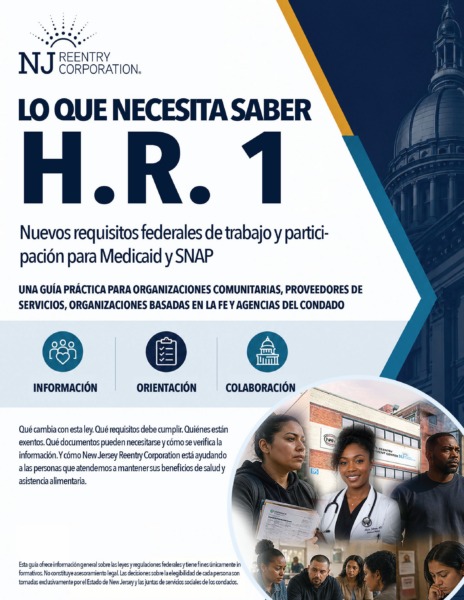
Partner Guidance 2026
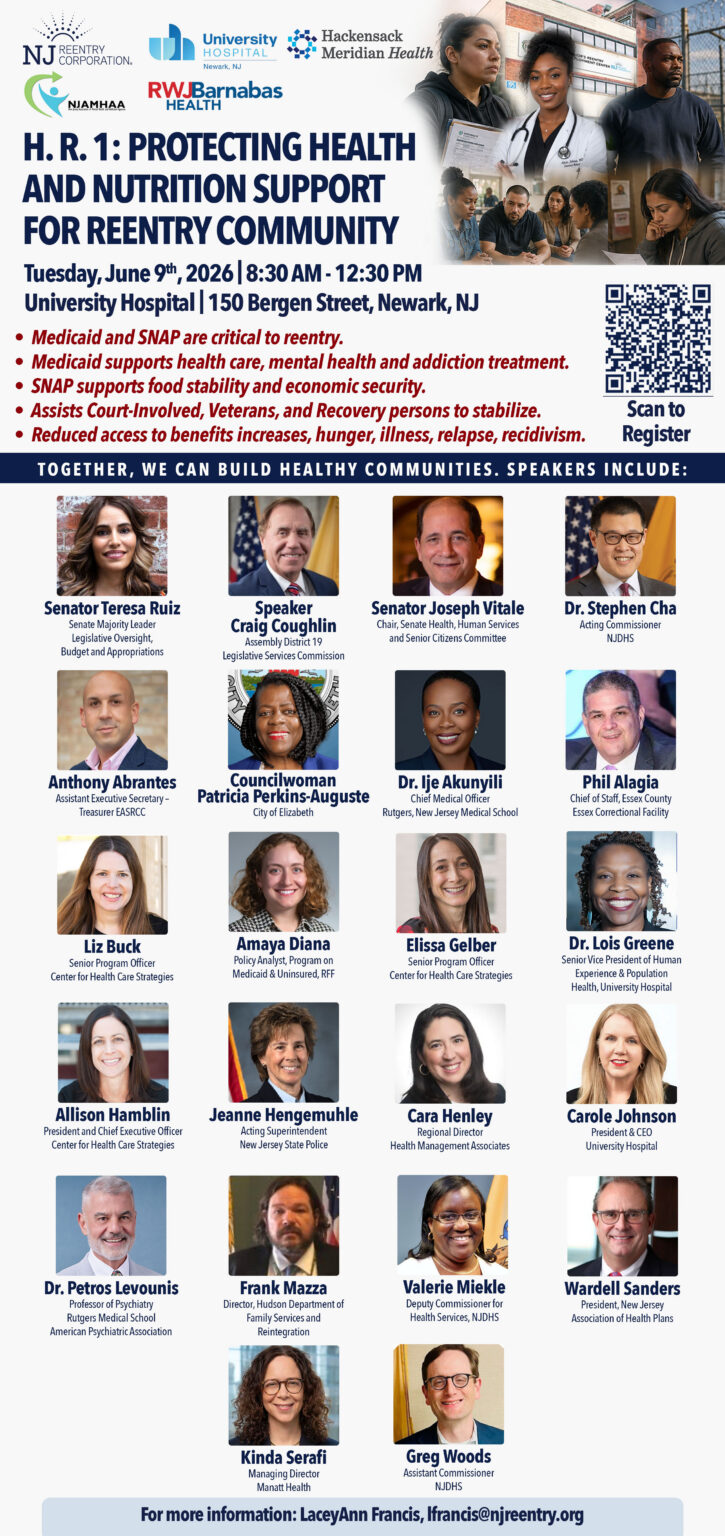
H.R. 1 Implementation Conference
June 9, 2026 — University Hospital, Newark
H.R. 1: Protecting Health and Nutrition Support for the Reentry Community
Time: 8:30 a.m. – 12:30 p.m.
Location: University Hospital, 150 Bergen Street, Newark, NJ
NJRC and University Hospital will convene a statewide conference focused on Medicaid, SNAP, CMS guidance, clinical exemptions, documentation standards, and regulatory compliance. The conference will address how New Jersey can protect healthcare and nutrition benefits for court-involved persons, veterans, and persons in recovery, particularly where medical, psychiatric, addiction-treatment, disability, or other documentation is required.
This conference will include healthcare providers, behavioral health and addiction-treatment professionals, Medicaid and SNAP administrators, managed-care organizations, public officials, legal-services providers, and community-based organizations.
To RSVP, visit www.eventbrite.com
Official State Resources: Check Eligibility, Renew Coverage, and Respond to Notices
The following official State of New Jersey websites can help you check whether new Medicaid rules may apply to you, renew your health insurance coverage, apply for SNAP food assistance, upload documents, and respond to notices.
NJRC can help you understand these resources, gather documents, review notices, and take the next steps. Final eligibility decisions are made by the State of New Jersey, County Social Service Agencies, NJ FamilyCare/Medicaid, or SNAP.
1. Check whether the new Medicaid rules may apply to you
NJ FamilyCare Checker
https://njfcchecker.nj.gov/screener/
Use this official State screening tool to check whether the new Medicaid rules may apply to you.
2. Apply for or renew NJ FamilyCare/Medicaid health coverage
NJ FamilyCare — Apply for NJ FamilyCare/Medicaid
https://njfamilycare.dhs.state.nj.us/apply.aspx
Use this website to apply for NJ FamilyCare/Medicaid. Online applicants can create an account, check application status, upload requested documents, and renew coverage online.
Stay Covered NJ — NJ FamilyCare/Medicaid Renewal Information
https://www.nj.gov/humanservices/dmahs/staycoverednj/coverage/
Use this website for renewal instructions, address updates, and guidance on responding to NJ FamilyCare, Medicaid, or county renewal mail.
Beginning January 1, 2027, certain NJ FamilyCare/Medicaid members may be required to renew their health coverage every six months, rather than once every twelve months.
3. Respond to Medicaid, NJ FamilyCare, SNAP, or county notices
County Social Service Agencies — Official County Office Directory
https://www.nj.gov/humanservices/dfd/counties/
Use this directory if your notice tells you to contact your County Social Service Agency, or if you need help with county-specific Medicaid, SNAP, WorkFirst NJ, or document-submission requirements.
MyNJHelps — SNAP / WorkFirst NJ Online Account, Application Status, and Document Upload
https://www.mynjhelps.gov/
Use this website to apply for SNAP or WorkFirst NJ, check your application status, and upload documents requested by the State or county.
Please do not ignore any Medicaid, NJ FamilyCare, SNAP, or county notice. If you receive a notice, bring it to NJRC as soon as possible so staff can help you understand what it means and what documents may be needed.
4. Apply for or maintain SNAP food assistance
NJ SNAP — Ways to Apply
https://www.nj.gov/humanservices/njsnap/apply/ways/
NJ SNAP — Eligibility Information
https://www.nj.gov/humanservices/njsnap/apply/eligibility/
NJ SNAP — Application Process
https://www.nj.gov/humanservices/njsnap/apply/app/
NJ SNAP — Work Requirements and Exemptions
https://www.nj.gov/humanservices/njsnap/employ/eligibility/
Use these official State SNAP pages to learn about eligibility, how to apply, what documents may be needed, work requirements, and possible exemptions.
Center for Health Care Strategies Work Requirements Implementation Series
These resources from the Center for Health Care Strategies outline key details about the new requirements and offer practical approaches to support implementation that minimize administrative burden and reflect the experiences of Medicaid members.
- A Summary of Federal Medicaid Work Requirements (Center for Health Care Strategies, July 2025). Synthesizes key details of the new federal Medicaid work requirements, including timeline, populations impacted, exemption categories, and more.
- Engaging Medicaid Members and Community-Based Organizations in Medicaid Work Requirements Implementation (Center for Health Care Strategies, July 2025). Outlines approaches states can use to partner directly with Medicaid members and community-based organizations in implementing work requirements that reflect community input and minimize coverage disruptions
- Connecting Medicaid Members to Work: Expanding Access to Evidence-Based Employment Models (Center for Health Care Strategies, August 2025). Outlines the evidence behind general workforce and supported employment programs and includes resources state agencies can use to prepare for work requirements implementation.
- Strengthening Cross-Agency Collaboration Across Medicaid and Other State Partners to Support Work Requirements Implementation (Center for Health Care Strategies, September 2025). Outlines opportunities for Medicaid agencies to collaborate with labor, education, corrections, SNAP, TANF, and other agencies to successfully address implementation challenges and maintain member coverage.
- Aligning Work Requirements Across SNAP and Medicaid to Support Public Benefit Continuity (Center for Health Care Strategies, October 2025). Compares work requirements in SNAP and Medicaid, and outlines strategies for state Medicaid agencies, SNAP-administering organizations, and other stakeholders to coordinate implementation across both programs.
- Data and Analytic Approaches for Medical Frailty Exemptions to Federal Medicaid Work Requirements (Center for Health Care Strategies, April 2026). Shares considerations to help streamline state adoption of the medical frailty exemption and minimize Medicaid application and renewal barriers for medically frail members.