
Optimizing Obstetric Care in Incarcerated and Reentry Populations

New Study on Optimizing Obstetric Care for Incarcerated and Reentry Populations Highlights NJRC Women’s Project and Continuity of Care Needs
Published in Journal of Gynecology and Women’s Health
July 2, 2026
A newly published peer-reviewed review in the Journal of Gynecology and Women’s Health, titled “Optimizing Obstetric Care in Incarcerated and Reentry Populations,” highlights the health risks facing pregnant women in correctional and reentry settings and calls for strengthened systems of care across prenatal, intrapartum, postpartum, and reentry phases.
The article emphasizes the need for early pregnancy screening, timely access to obstetric and maternal-fetal medicine (OB/GYN and MFM) care, structured postpartum planning, behavioral health support, and strong linkage to community-based providers to ensure continuity of care beyond incarceration.
The review identifies persistent gaps in correctional healthcare systems, including inconsistent intake screening, delayed evaluation of obstetric symptoms, limited access to medication-assisted treatment for substance use disorders, and disruptions in care continuity during reentry. It further notes that labor and delivery can be affected by custody procedures that limit mobility, privacy, and support persons, while postpartum care is often shortened and insufficiently coordinated.
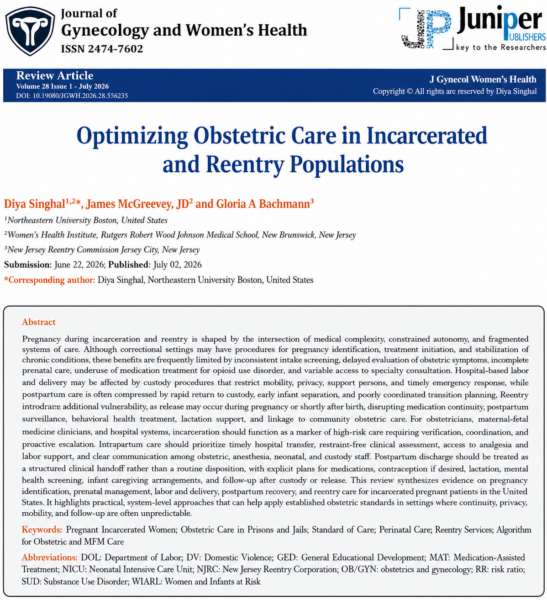
Importantly, the authors underscore that incarceration should be treated as a high-risk marker in obstetric care, requiring coordinated communication between correctional facilities, hospitals, and community health systems.
The study recommends structured clinical approaches including restraint-free labor management, improved interprofessional communication, expanded behavioral health services, and comprehensive postpartum discharge planning that includes mental health screening, lactation support, contraception counseling when appropriate, and follow-up care after release.
We are grateful to our Medical Director, Dr. Gloria A. Bachmann of Rutgers Robert Wood Johnson Medical School, and to Diya Singhal for including the New Jersey Reentry Corporation (NJRC) in this important research.
The review recognizes NJRC’s Women’s Project as a coordinated reentry model that connects women to essential services including Medicaid enrollment, medical care, behavioral health services, medication-assisted treatment, legal support, case management, and workforce preparation.
We especially thank Dr. Bachmann for her longstanding commitment to caring for women incarcerated at Edna Mahan Correctional Facility for Women and for her continued leadership as NJRC Medical Director. We also extend appreciation to the Journal of Gynecology and Women’s Health for publishing this important work.
This publication reinforces the urgent need for system-level coordination to ensure that pregnant individuals in incarcerated and reentry settings receive care aligned with established obstetric standards, improving outcomes for both mothers and infants.